Retirement Is Out.
Vitality Is In.

Let's get started.
Written by

Read time
7 minutes
Category
Rewriting the longevity narrative.
We just wrapped up four days at the LeadingAge BOLD Conference in Palm Desert, alongside industry innovators and heavy hitters—including progressive leaders from our client, Episcopal Communities & Services (ECS). The overriding consensus? Institutionally focused senior living has simply run its course, and we’re on to what’s next. The future belongs to brands that view longevity as a hard-won victory to be optimized, not a medical problem to be managed.
A good strategy for victory isn’t wishful thinking or a checklist of what everyone else is doing. To be there for older adults you need to identify the real crux of your operation and design a response that levels up residents' lives.
Here’s some real-world operational intelligence to consider.
1. Lifespan to Healthspan
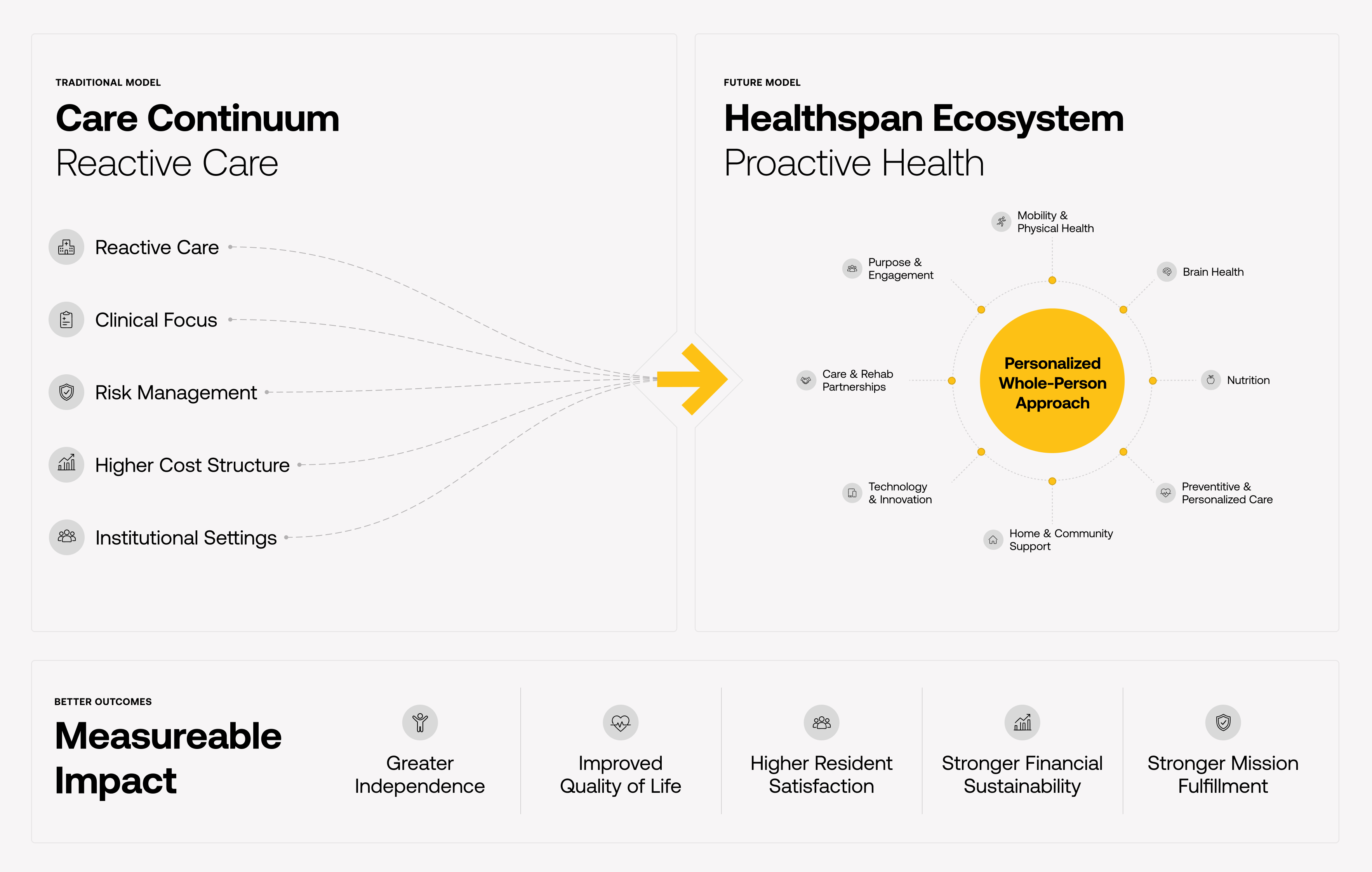
When was the last time you took a hard look at your value proposition? Is it still relevant? For decades, the industry has sold a reactive framework designed to manage illness and decline. It was a traditional clinical model built around waitlists and care when you need it.
The data from the Ziegler CFO Hotline Survey dropped a striking truth: Nearly 86% of incoming residents consider managing healthspan very important. They aren't looking for an institutional safety net, they want wellness real estate that functions like a boutique hotel. Is this how you would describe your community?
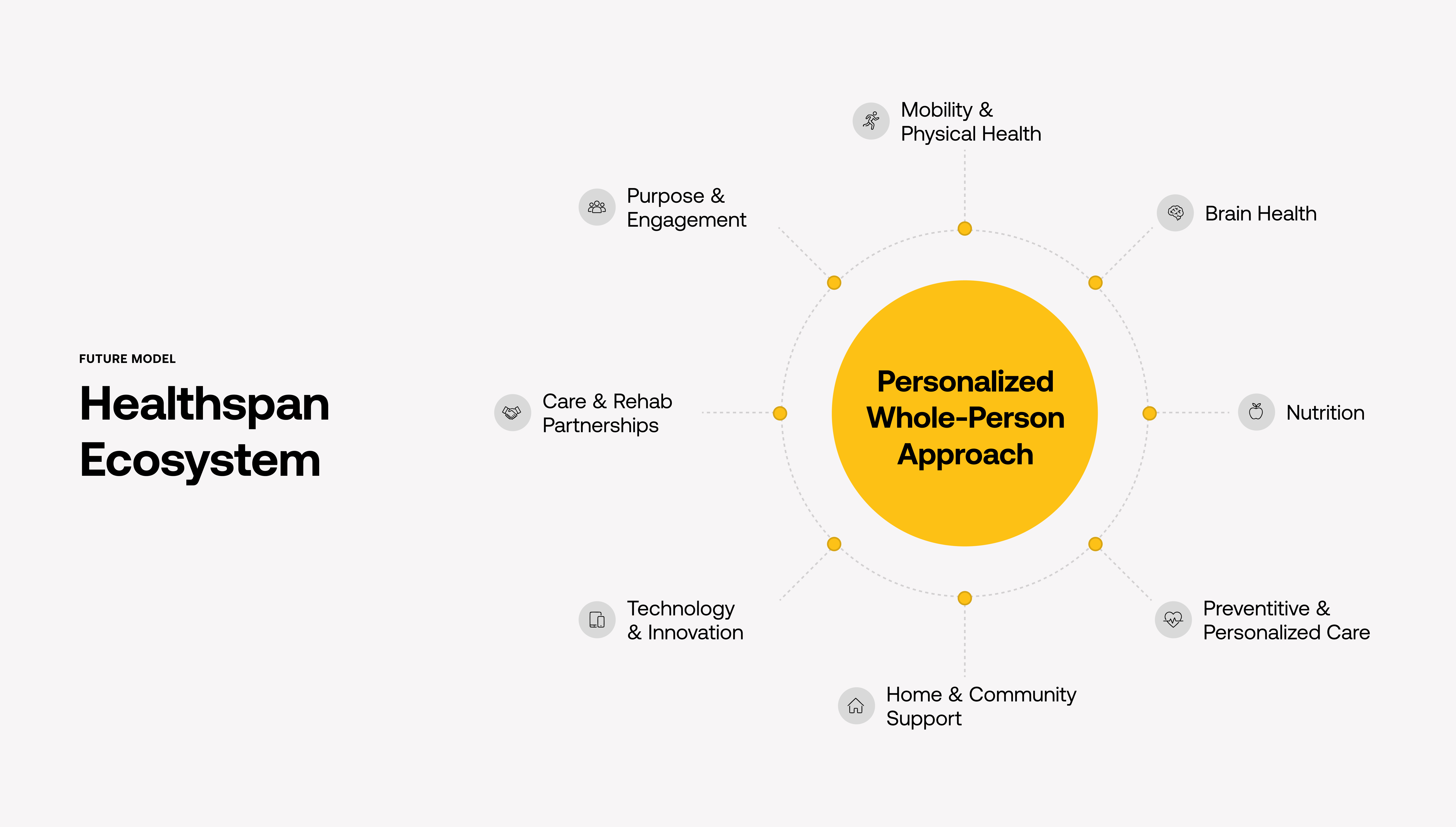
The modern value model is a Healthspan Ecosystem built around physical longevity, cognitive resilience, and environmental lifestyle design. The target isn't just adding years to life — it's adding vibrant, independent life to those years. If your brand is still pitching reactive clinical support instead of vitality worth noticing, you are missing the desires of your buyer.
Brand truth: Stop marketing amenities. Start positioning vitality.
Prospects aren't choosing your community for the brick-and-mortar pool or the standard gym checklist. They are buying into the narrative of sustained autonomy and a life well lived. If your brand positioning is still anchored in property investments rather than personalized, life-extending outcomes, you’re selling commodities to a lifestyle buyer.
2. Enhanced Assisted Living
Traditional Skilled Nursing Facilities (SNFs) have an unfortunate rep. Just saying the phrase conjures imagery of scary hallways and unmet needs told in dramatic story fashion by your grandmother’s grandmother. They are also operationally challenging: overregulation, punitive citation systems, inadequate reimbursement, and negative public perceptions. While Skilled Nursing certainly has its place and serves a specific need, the traditional model is no longer how most residents want to receive care.
The solution is an inspired movement toward Enhanced Assisted Living and high-acuity Care Suites. Leaders from Monte Vista Grove Homes and ECS outlined how they successfully transitioned from Skilled Nursing and reinvested into expanded, higher-acuity assisted living environments that people actually want to rest and recover in.
Forward-thinking operators are diving into what really matters when you need extra care, and bringing medical services to the resident rather than forcing a traumatic move across care levels. They’re practicing caring in place in the least restrictive, most life-affirming environment possible. They’re thinking big and acting even bigger, setting an example of how to work within a structured system to deliver the care people need and want.
Brand truth: You don’t have to roar. Just get the message right.
It doesn’t matter how good the story is if you’re speaking to the wrong people. Shifting care needs require precise storytelling. Do you know what your Ideal Customer profile (ICP) looks like now? If your narrative is attempting to target with clinical uninspired messaging, you don’t have a chance. Meet your buyers exactly where they are in their journey.
3. Housing the Age Wave
What will we do when there just isn’t enough room for everyone? Mid-market innovation is crucial and starts now. The demand is growing massively, but the supply just isn’t there. NIC MAP data shows inventory growth is at near-record lows while CCRC occupancy climbs near 92%. To effectively serve older adults through 2030, over 600,000 additional homes will be needed.
But building massive, full-continuum Life Plan Communities from scratch is capital-intensive and slow. Enter the rise of the Satellite Campus.
Innovators are expanding with smaller-scale but creative planning. Think Independent Living with satellite properties located within walkable, master-planned developments. These properties allow brands to leverage the parent campus's positioning, operations and resources, while capturing the unserved middle-market at a highly competitive development cost with a faster timeline. They also allow you opportunity for those upgraded environments that hit the longevity and wellness lifestyle active older adults are looking for.
Brand truth: Market shifts are inevitable. Being invisible is optional.
The housing shortage means supply is low, but the battle for consumer mindshare is at an all-time high. Communities that build a clear, distinctive digital footprint before groundbreaking walk away with the waitlist.
4. Meet the Tech-Enabled Modern Adult
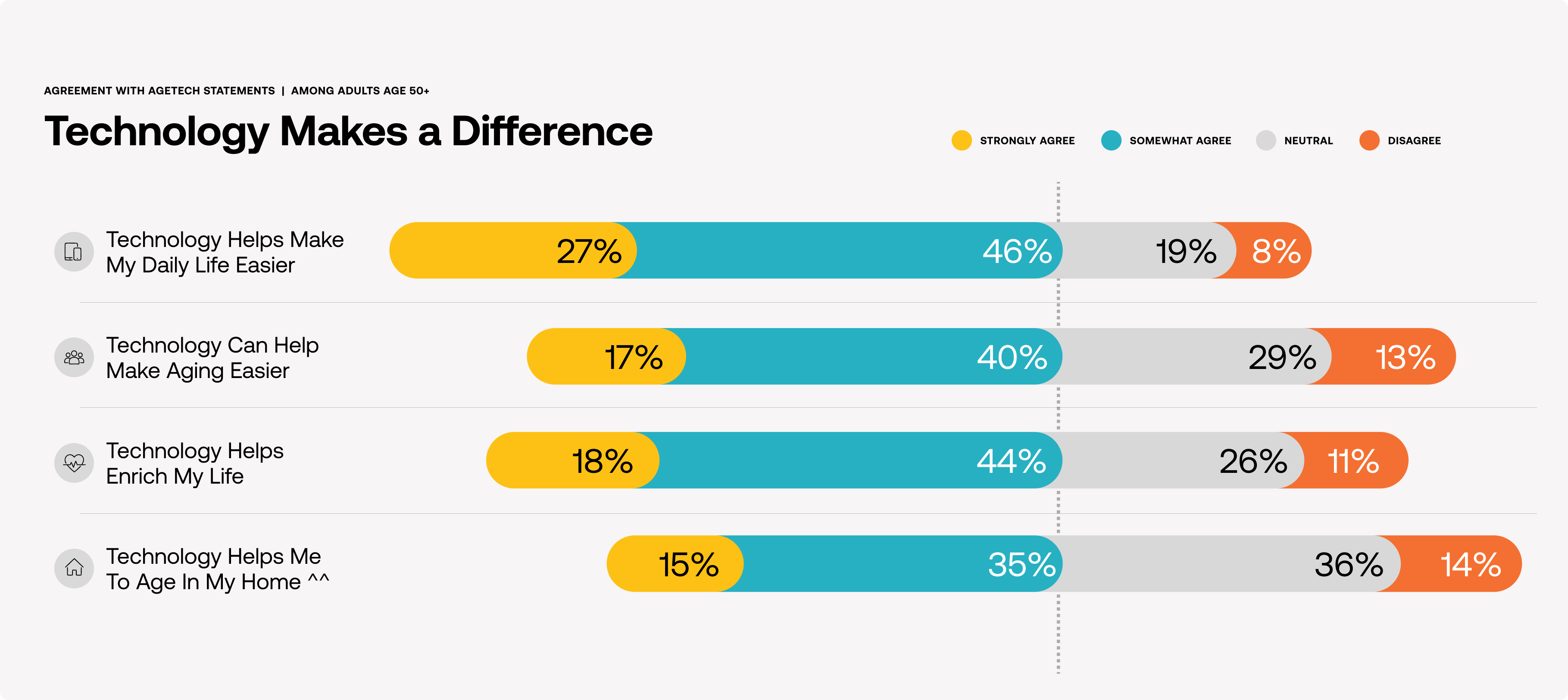
There was an unmistakable buzzword echoing across every panel that I’m sure you can guess: AI. And while there are days I would like to ignore this part of the conversation, we can’t ignore that Artificial intelligence has moved out of IT experimentation and directly into the inner workings of resident operations. Generative AI use among adults over 50 has literally tripled in the last two years, driven almost entirely by tools that seamlessly integrate into their daily routines—from advanced voice UI interfaces to smart home environmental controls and predictive anti-scam monitoring.
Behind the scenes, technology like ambient radar, smart sensors, and automated data tracking are quietly forming an invisible safety net across smart communities. Imagine sound sensors that can detect fall risk by hearing the behaviors in a room. But let’s be perfectly clear — technology succeeds only when it’s rooted in absolute transparency and trust.
Older adults are highly sophisticated, tech-curious, and fiercely protective of their privacy. They don't want gimmicks or intrusive cameras, they want invisible infrastructure that preserves their dignity, enhances their personal autonomy and creates connection and delight.
Brand truth: You don't need more leads. You need a faster path to trust.
Trust is built or broken in discovery using tech. A good place to start is a website that is easy to use and understand. Think clear, accessible 24/7 chat to answer questions instantly, seamless CRM connections that respect prospects time, and fully inclusive, ADA-compliant designs that make reading, navigating, and exploring effortless for everyone.
(Stay tuned and will break this topic down even more in our next deep-dive blog: Code Name 'Lizard Brain.')
5. Precision Wellness
Speaking of wellness, it has to be more than just a marketing term you throw into collateral. The modern prospect does not buy into fluff. The average buyer completes a staggering 70% of their decision-making journey entirely in the shadows before ever initiating contact with sales. They’re going to deep dive into your data, pricing, and lifestyle fit before stepping foot on the property.
When they do choose their new home and move in, they expect scientific validation that the place they’re choosing will continue to expand their life. HumanGood shared data from their latest healthspan pilot program using tools like BrainHQ and specialized functional fitness assessments. The results showed 14 out of 22 residents measurably improved their cognitive scores, loneliness rates plummeted by 78.2%, and functional fitness tracking showed massive jumps in single-leg balance and endurance. This is the kind of forward-thinking precision proof that helps your residents feel confident about the future they are choosing with you.
Brand truth: Clarity isn’t a luxury. It’s a performance multiplier.
A premium wellness strategy fails if your internal team isn’t aligned on how to talk about it. Does your workforce know how to speak to this new paradigm in wellness? If you haven't explicitly defined how wellness integrates directly into your daily service model and team behaviors, your external marketing is just an empty promise your operational reality can't keep.
The Bottom Line
When you change the way you talk about aging, you change the way people experience your community. Stop selling the destination where people go to give up in slow retreat. It’s time to market a vibrant launchpad for their next great chapter.
Let’s re-architect your narrative before your next tour?
More
insights
©2026 300FeetOut All Rights Reserved | Open Positions | Privacy Policy